


Uneven floors are one of the most common challenges in UK homes, particularly in older properties, conversions, and extensions. The wrong flooring choice on an uneven subfloor leads to visible gaps, creaking, premature wear, and even trip hazards — but the right product can disguise imperfections while lasting for years.
This guide covers the best flooring options for uneven surfaces, how to assess your subfloor, and when levelling is worth the investment versus working with what you’ve got.
How to Assess Your Uneven Floor
Before choosing flooring, you need to understand what you’re working with. Place a 2-metre straight edge (or spirit level) on the floor and check the gaps underneath:
- Under 3mm variation — most flooring types will work fine without additional preparation
- 3–5mm variation — some flooring types will cope, but you may need thicker underlay or flexible products
- Over 5mm variation — most rigid flooring will fail. Either level the subfloor first or choose highly flexible products
- Over 10mm variation — levelling is essential before any flooring installation
Also identify the type of unevenness: is it a gradual slope (common in older houses), localised dips and bumps, or warped/cupped boards? Each requires a different approach. For a deeper look at causes and fixes, see our guide on how to fix uneven floors.
The 6 Best Flooring Types for Uneven Floors
1. Luxury Vinyl Tiles (LVT) — Best Overall Choice
LVT flooring is the single best option for moderately uneven floors. Flexible vinyl planks and tiles conform to minor imperfections rather than bridging over them (which causes stress and cracking in rigid products).
- Glue-down LVT — the best performer on uneven surfaces. Conforms directly to the subfloor contours (tolerates up to 5mm variation)
- Loose-lay LVT — heavy and flexible, stays in place without adhesive. Good for moderate unevenness
- Click-lock LVT — less forgiving than glue-down (requires flatter surface, max 3mm) but still better than laminate or wood
LVT is also 100% waterproof, low-maintenance, and available in realistic wood and stone designs. It’s the go-to recommendation for kitchens, bathrooms, and hallways with imperfect subfloors.
2. Sheet Vinyl — Most Forgiving
Sheet vinyl (continuous rolls rather than planks/tiles) is the most tolerant flooring for uneven surfaces. Because it’s a single flexible sheet, it drapes over bumps and dips without creating joints that can lift or gap.
- Tolerates the highest degree of unevenness of any flooring type
- No seams to catch or lift over bumps
- Budget-friendly (from £8/m² installed)
- Available in cushioned versions that absorb minor imperfections
- Downside: less premium appearance than LVT or wood
3. Engineered Wood — Best for Natural Wood Look
If you want real wood on an uneven floor, engineered wood is far better than solid hardwood. Its layered construction resists warping and the thinner profile (14–20mm) is more adaptable than 22mm solid boards.
- Floating installation with thick underlay (3–5mm) helps absorb minor unevenness
- More dimensionally stable than solid wood — won’t cup or twist as much on imperfect subfloors
- Still requires subfloor within 3mm/2m — won’t bridge large dips
- Consider wider planks (180mm+) which visually disguise slight undulation better than narrow boards
4. Carpet — Hides Everything
Carpet with a thick underlay is the classic solution for hiding uneven floors. The combination of padding and pile conceals virtually any imperfection from view and touch.
- Thick underlay (10–12mm) bridges significant dips and bumps
- Visually hides all unevenness — you can’t see subfloor contours through carpet
- Best for bedrooms and living rooms where water exposure isn’t a concern
- Won’t fix structural issues — the floor underneath remains uneven
- Doesn’t work for kitchens, bathrooms, or high-moisture areas
5. Carpet Tiles — Flexible and Replaceable
Carpet tiles offer similar unevenness-hiding properties to broadloom carpet, with added flexibility: individual tiles can shift independently, accommodating floor movement better than a single stretched carpet.
- Each tile adjusts independently to the subfloor
- Damaged tiles can be replaced individually (great for rentals)
- No stretching required — simply loose-lay or stick down
- Commercial-grade options (like office carpet tiles) are extremely durable
6. Laminate — Budget Option (with Caveats)
Laminate flooring can work on slightly uneven floors but is less forgiving than the options above. The rigid HDF core means it bridges rather than conforms — creating hollow spots that creak and stress the click-lock joints.
- Maximum tolerable unevenness: 2–3mm over 2 metres
- Thicker laminate (10–12mm) with quality underlay helps compensate
- Expect some creaking if the subfloor isn’t near-perfect
- Avoid cheap thin laminate (7–8mm) on uneven floors — joints will fail quickly
- Consider thicker laminate options if you choose this route
Should You Level the Floor First?
Sometimes levelling is more cost-effective than choosing flooring that tolerates unevenness:
- Self-levelling compound — £15–£30/m² (materials + labour). Creates a perfectly flat surface for any flooring type. Best for concrete subfloors with dips up to 10mm
- Plywood overlay — £10–£20/m². Screwing 6mm plywood over uneven timber boards creates a flat, stable base. Adds minimal height
- Floor sanding — £15–£25/m². Only for timber boards that are high in spots. Removes material to create a level plane
Level first when: the unevenness exceeds 5mm, you want rigid flooring (wood/laminate), or you’re investing in premium products that deserve a proper base.
Work with it when: the budget is tight, unevenness is under 5mm, you’re choosing flexible flooring (vinyl/carpet), or the room is low-traffic.
Flooring to Avoid on Uneven Floors
- Solid hardwood — rigid, expensive, and will gap/creak badly on uneven subfloors
- Large-format tiles (ceramic/porcelain) — crack under point loading when unsupported by an uneven base; grout lines crack and fail
- Thin rigid vinyl (2mm SPC) — too rigid and thin to bridge imperfections; click joints fail under stress
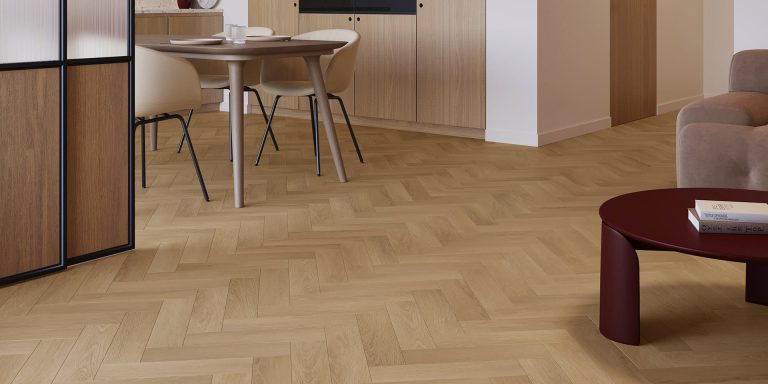
- Herringbone/parquet patterns — the many small joints amplify any subfloor unevenness visually
Frequently Asked Questions
What is the easiest flooring to install on uneven floors?
Sheet vinyl and carpet are the easiest because they’re flexible and conform to the subfloor without precise levelling. For a DIY-friendly option that looks more premium, glue-down LVT planks are straightforward — simply apply adhesive and press into place, letting the vinyl conform to minor contours.
Can you lay laminate on an uneven floor?
Only if the unevenness is under 3mm over a 2-metre span. Beyond that, laminate’s rigid core will bridge dips (creating hollow spots that creak), stress click-lock joints until they fail, and wear unevenly. If your floor exceeds 3mm variation, either level it first or choose a more flexible product like LVT.
How much does it cost to level a floor before installing new flooring?
In the UK, expect £15–£30/m² for self-levelling compound (materials and labour), £10–£20/m² for a plywood overlay on timber subfloors, or £15–£25/m² for floor sanding. A typical 15m² room costs £225–£450 to level — often less than replacing flooring that fails prematurely on an unprepared surface.
Is LVT or laminate better for uneven floors?
LVT is significantly better. Flexible vinyl conforms to minor subfloor imperfections (especially glue-down LVT), while rigid laminate bridges over them — creating creaking, joint stress, and premature failure. LVT also handles moisture, making it suitable for kitchens and bathrooms where uneven floors are common in older homes.
Do I need underlay on uneven floors?
Yes — a quality underlay is essential on uneven floors. For laminate and floating floors, choose a thicker underlay (3–5mm) with good compression resistance to absorb minor imperfections. For carpet, 10–12mm underlay hides virtually all unevenness. For glue-down vinyl, underlay isn’t used (the adhesive bonds directly to the subfloor), but the surface must be prepared with levelling compound first.
Need help choosing the right flooring for your uneven subfloor? Browse our full range of LVT flooring or book a free consultation with our flooring specialists for personalised advice on your specific situation.
Related guides: